
We rarely wake up one morning and suddenly become a different person. Most of the time, who we are is built in much quieter moments: one decision, one refusal, one attempt, one avoidance, one thing we chose to do even when nobody was watching. Only later do we look back and realize how far those moments have carried us.
That idea sits at the center of Evolournal. When you create a journal entry, a task, or a timer session, you may see prompts such as “What small evidence today points toward the person you want to become?” or “Who are you becoming through this?” You can connect each entry or action to an Identity Card, a concrete description of the person you want to grow into. When you complete the action, that card lights up. Something as abstract as “becoming a better version of myself” suddenly has a visible piece of evidence behind it.
This process is already happening in everyday life. Much of what we believe about ourselves comes from evidence accumulated over time. You begin to think “I’m reliable,” “I keep looking for solutions when things get difficult,” or “I can say what I really think” after repeatedly seeing yourself act that way. The same process works in the other direction. Repeated choices can slowly turn into a story about who we think we are.
That is why I keep coming back to one question: “In this moment, who do you choose to be?”
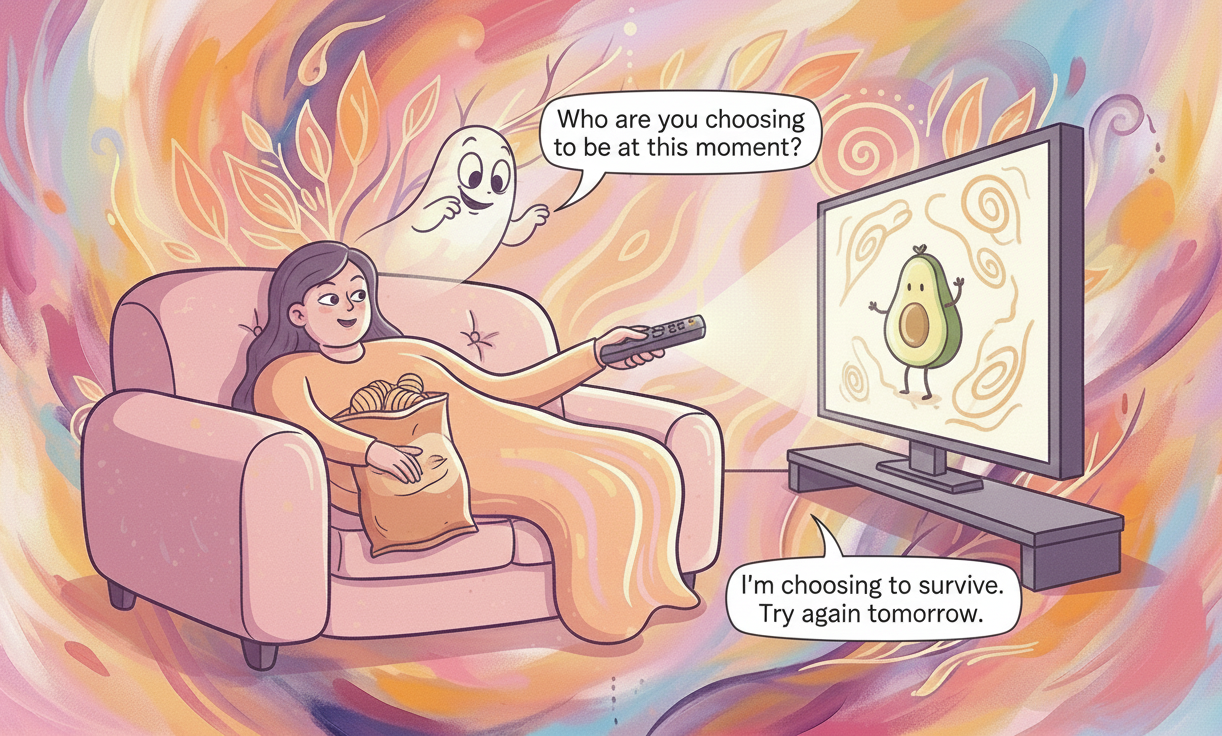
You definitely do not need to ask yourself this every hour of every day. After a long day, when all you want is a sofa, a bag of chips, and the least intellectually demanding show you can find, an existential question hovering over your head is probably the last thing you need. Rest, idleness, and doing absolutely nothing useful for a while all belong in a human life.
The question matters most at moments that can change your direction. Do I take this opportunity? Do I leave an environment that no longer fits me? Do I finally begin the thing I have been afraid of? Do I stay in this relationship? Do I accept the risk that comes with pursuing something I genuinely care about? “What should I do?” can feel impossible to answer. “Who do I want to be here?” can sometimes make the choice clearer.
Choosing a direction does not teleport you to the outcome. You still have to live through the small, repetitive, sometimes boring steps in between. During that process, “Who am I becoming?” can work as a way to check your course. When your actions match the direction you chose, the question reminds you to keep going. When the same goal repeatedly leaves you feeling deeply resistant, drained, or disconnected, it may be time to examine it again. Do I still want this life? Why am I pursuing this? Do I still believe in the reason that made me choose it?
Your “ideal self” can simply mean the values, qualities, abilities, and way of living you hope your future self will embody. The difficulty is that we often describe that person with huge words: successful, confident, excellent, a leader. They sound meaningful, yet they rarely tell us what to do tomorrow morning.
In Evolournal, this idea takes the form of Identity Cards, one of the core parts of the product. Journal entries, tasks, and timer sessions can all be connected to them. How you define an Identity Card therefore matters. A clear identity can enter your daily life. A vague one tends to stay somewhere in the distance. Here are three principles I have found useful while designing and using this system.
1. Make the standard specific enough that you know what to do next
Words like “successful,” “happy,” and “confident” are easy to want and hard to act on. What counts as something a successful person can do today? What single action proves that you are already confident? When an identity cannot connect to behavior, it can easily turn into another standard hanging over your head.
If you write down “successful,” keep asking questions. What does success actually mean to me? What part of it attracts me? Maybe you want recognition. Maybe you want financial freedom. Maybe you want to build things you genuinely believe in. Maybe you want your work to improve other people’s lives. Each answer points toward a very different path.
The same applies to confidence. What kind of confidence do you admire? How would a confident version of you respond to criticism, failure, unfamiliar environments, or someone you deeply care about? Who already carries the kind of confidence you want? What exactly do they do that makes you perceive them that way? What experiences would make you sincerely think, “I handled that well. I can trust myself”?
The goal of these questions is to take a beautiful, blurry word and keep digging until you reach something you actually care about. You can do this alone, with someone you trust, or with AI. A useful test is simple: when you look at an Identity Card and can immediately think of one thing you could do today to embody it, the definition is probably concrete enough.

2. Use qualities you can practice, instead of titles other people have to give you
“Excellent,” “successful,” and “leader” depend heavily on outcomes, positions, opportunities, and other people’s judgments. You may already be doing meaningful work and still feel that you have not earned the label.
Try describing the qualities underneath the label.
If you hope to become a trustworthy leader one day, your Identity Cards might say “take responsibility without waiting to be told,” “move problems toward solutions,” “help people around me use their strengths,” or “take ownership of the team’s outcome.” You do not need a management title to start practicing any of those things.
This also shifts your attention back toward what you can influence. You cannot fully control when an opportunity appears, when a position opens, or when someone recognizes your ability. You can keep developing into someone capable of carrying that opportunity when it arrives.

3. Find the causes you can repeat, instead of focusing only on the outcome
Suppose your goal is to become “good at choosing the right collaborators.” That is difficult to practice every day because the moment of actually choosing a collaborator does not happen very often. So go one level deeper. What does someone who consistently chooses good collaborators pay attention to?
Maybe they regularly notice other people’s strengths and potential. Maybe they watch how someone behaves under pressure. Maybe they understand what kind of people complement their own way of working. Maybe they pay attention to values and working styles early in a relationship. All of those are skills you can practice repeatedly.
Many outcomes we want sit on top of a deeper set of habits, sensitivities, and abilities. Once you find those underlying causes, the path becomes much easier to see.
If you open Evolournal and feel stuck staring at the Identity Cards you have created, check whether they have become too large, distant, or abstract. When your ideal self always seems to live somewhere far away, your attention naturally falls on the gap between where you are and where you think you should be. That gap can quickly turn into anxiety.
You do not need to prove that you have already become that person. Make the goal smaller. Make it clearer. Find one thing you can do today, then do it. Rest when you are tired. Reconsider the direction when something keeps feeling wrong. A person is often shaped through these tiny course corrections.
You may not be where you want to be yet. Your current position does not tell the whole story. The direction your boat is facing matters too.
Years later, when you finally arrive somewhere that once felt impossibly distant, you may realize that the moments that changed your life were surprisingly ordinary. Maybe there was simply a day when you noticed you were drifting, put your hands back on the wheel, and turned a little closer toward the life you actually wanted.

Once you know who you want to become and have found a direction you can actually act on, another question appears: how do you keep going when the excitement fades, resistance shows up, and you start doubting yourself?
That is what the next article will be about.